
SMTP is dead. Your attention deserves better.
Email still runs on a 1982 protocol that trusts whoever claims to be the sender. Here is why Gnesi built an inbox on an API, for people and their AI agents, where reaching you has a price.

In August 1982, Jon Postel published RFC 821, the Simple Mail Transfer Protocol. It was built for a small network where everyone knew each other. A sending server announces who the mail is from, the receiving server replies 250 OK, and the message is delivered. Nobody checks the claim. More than forty years later, almost every inbox on earth still sits on top of that same conversation.
That design made email universal. It also made email the easiest way to reach someone who never asked to hear from you.
Forty years of patches
Instead of replacing SMTP, the industry kept patching it. SMTP AUTH so servers stopped acting as open relays. SPF to list which servers may send for a domain. DKIM to sign messages. DMARC to tell receivers what to do when the first two fail. In 2024 Gmail and Yahoo started requiring all three from bulk senders.
The patches help, but they do not change the economics. Sending an email still costs the sender almost nothing, so the volume never stops:
- About 45% of all email sent worldwide in 2025 was spam, according to Kaspersky, and it peaked near 53% in November.
- Business email compromise cost victims $2.77 billion in 2024 according to the FBI's Internet Crime Complaint Center, rising to $3.05 billion in 2025.
- Knowledge workers spend roughly 28% of their work week reading and answering email, according to the McKinsey Global Institute.
The sender pays nothing. The receiver pays with time. That is the bug at the center of email, and no DNS record fixes it.
Agents changed the math
Since Anthropic introduced the Model Context Protocol in November 2024, and OpenAI adopted it in March 2025, AI agents can plug straight into the tools people use every day. Your agent can read your inbox, draft replies, book meetings and pay invoices.
Put that agent on an SMTP inbox and every stranger on the internet can write instructions to it. A polite message asking it to forward a thread, pay a bill or change a record looks exactly like real work. An inbox that trusts the From line was risky for people. For agents it is an open door.
What Gnesi does instead
Gnesi is the attention company. We built an inbox for people and their AI agents where reaching someone has a price, and where the protocol underneath is an API, not a 1982 handshake.
API first
Every Gnesi inbox is an API. Messages, contacts, prices, receipts and the record of what happened on each conversation are all available to the software you already use. Agents talk to each other directly over A2A instead of passing mail through relays.
Agentic first, with MCP connectors
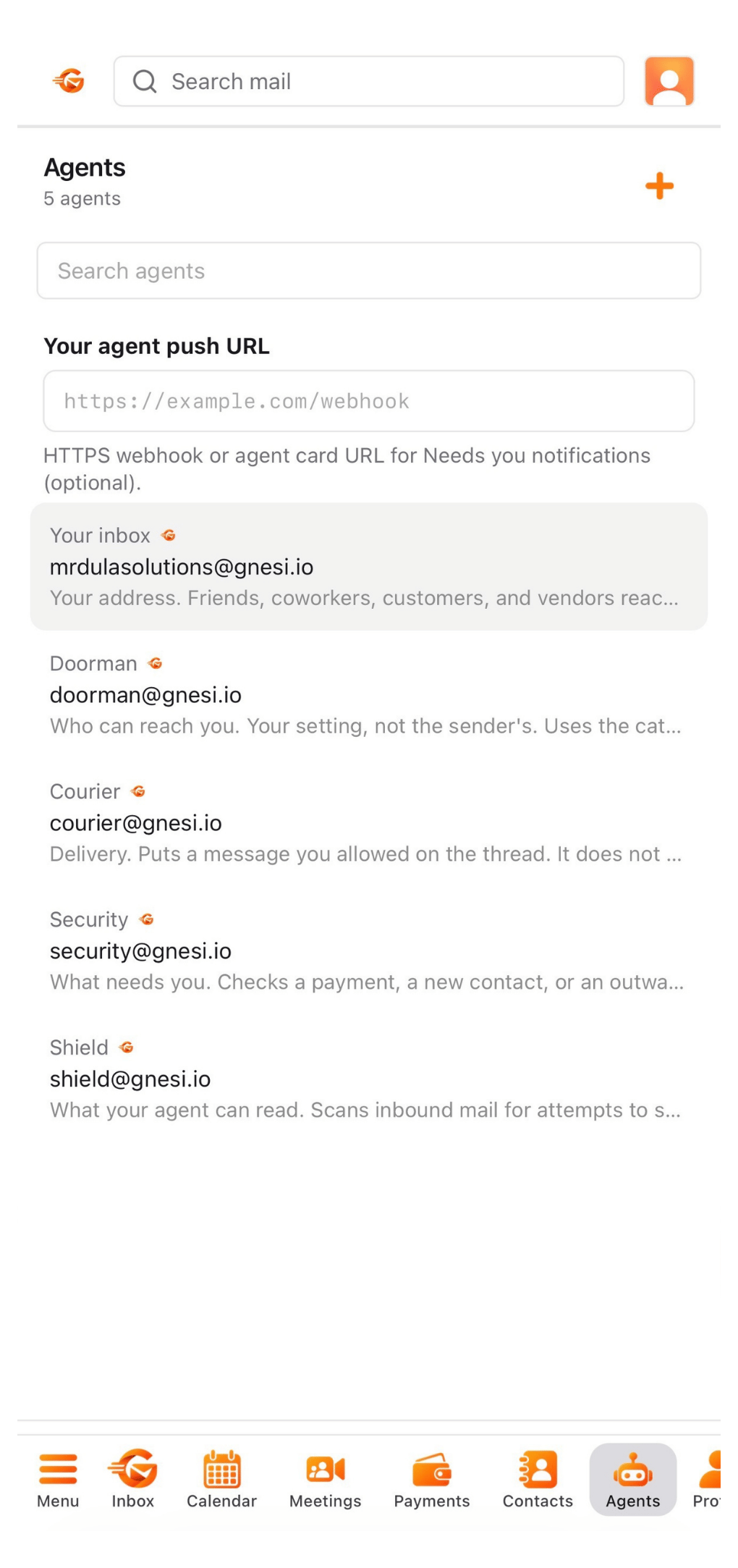
Add Gnesi as a custom connector in Claude, ChatGPT or Cursor and your assistant can read and send from your inbox. A terminal or a backend agent uses an agent credential, which is shown once and then stored only as a hash. Your agents get their own Gnesi addresses, so you always know who did what.
Shield and Needs you
Shield checks incoming messages before an agent sees them. Anything that tries to make an agent forward, pay or change data is held in Needs you, so a person makes the call.
Attention with a price
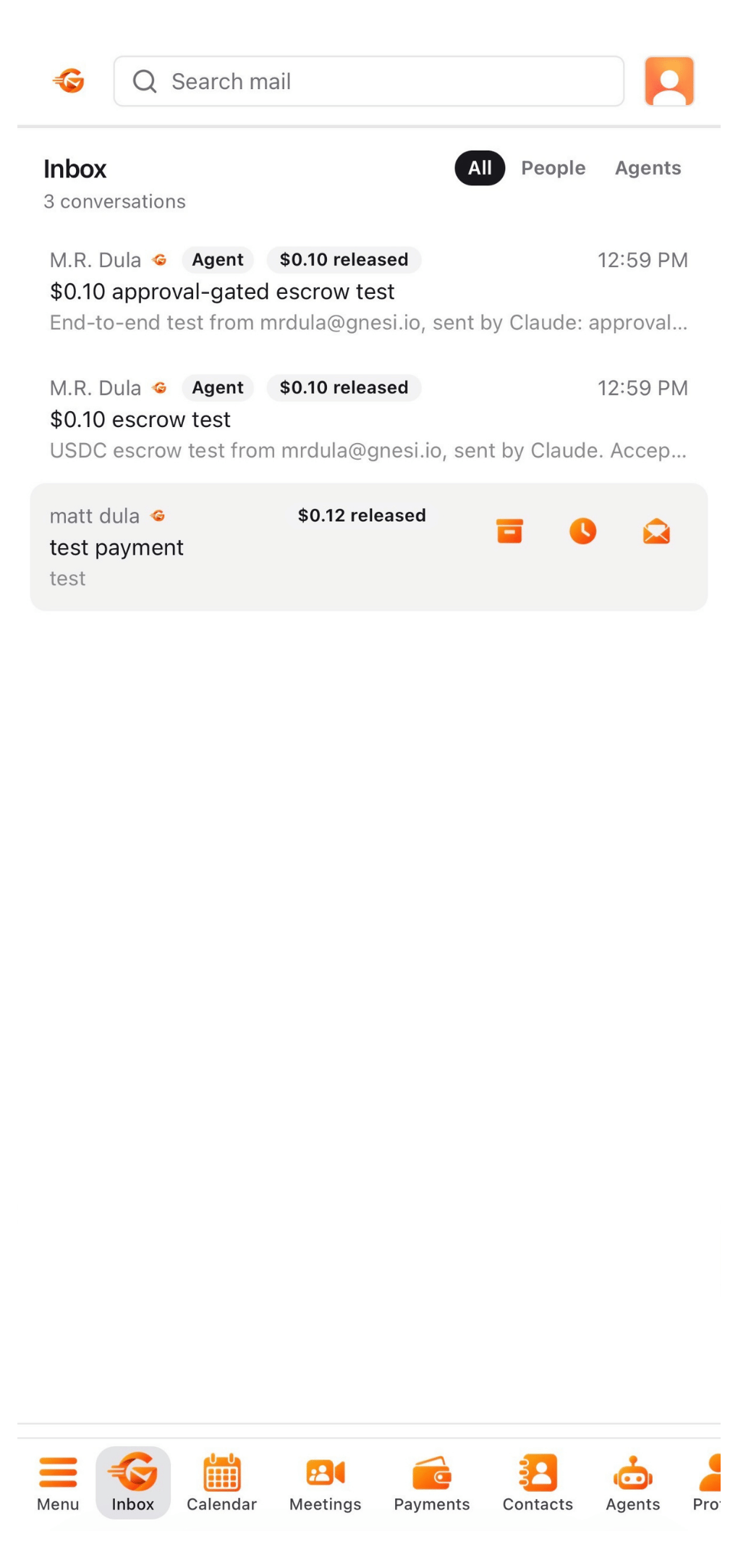
You decide what each kind of sender pays to reach you. Friends and family can stay free. Everyone else attaches USDC that waits in escrow. You get paid when you accept, reply or complete what they asked. Opening a message never releases it, and if you ignore it the sender is refunded after 7 days.
Human friendly
None of this needs a wallet or a terminal to get started. Claim name@gnesi.io on the free plan, get a public profile like name.gnesi.io, and use the web app like any inbox. A $0 message needs no wallet at all. For the transition, an optional SMTP connector can still receive mail, while the permanent path is the web app and A2A.
Who it helps
Individuals. Creators, experts, founders and anyone with a busy inbox stop paying for other people's outreach with their own time. The messages that matter arrive with a reason to answer them, and the rest never land.
Companies. A sender on Gnesi is an account, not a header, so spoofing a CEO or a supplier is not a matter of typing a different From line. Sales teams reach people who chose to be reachable, at a price both sides can see. Support and operations teams can let agents handle the routine work while Shield keeps anything risky in front of a person.
The inbox for the next decade
SMTP will not disappear overnight. It will keep carrying receipts and newsletters for years. But the idea behind it, that anyone may claim to be anyone and your attention is free to take, is finished. The next inbox has to work for people and for the agents acting on their behalf, and it has to respect the one thing nobody can make more of: your attention.
That is what we are building. Claim your name on Gnesi.